what to do if youre having a stroke
When a person is having a stroke, every 2nd counts. And what you do in those critical moments tin can potentially help save someone's life.
Kelley A. Humbert, MD, Assistant Professor of Clinical Neurology at Penn Medicine, spells out of import do's and don'ts, and then you can be set up to requite your loved one the best take a chance of surviving a stroke.
A stroke is often described as a "brain attack." Part of the encephalon is robbed of the oxygen and blood supply information technology needs to role, because a blood vessel to part of the brain either has a clot or blockage, or bursts.
The longer a stroke goes untreated, the more brain cells die. Merely there are treatments that can be given if a person reaches the hospital in time.
Three Things to Practice When Someone Is Having a Stroke
1. Phone call 911 immediately
If yous do naught else, act rapidly to call 911.
"The hardest thing you have to do is recognize symptoms of a stroke," Dr. Humbert explains. "If you do observe any symptoms, you should call 911 immediately. Yous should also immediately tell the 911 dispatcher, 'I remember I'one thousand having a stroke' or 'I retrieve my loved one is.'"
Not sure what the symptoms of a stroke are? Requite someone you recollect is having a stroke this FAST test from the National Stroke Association.
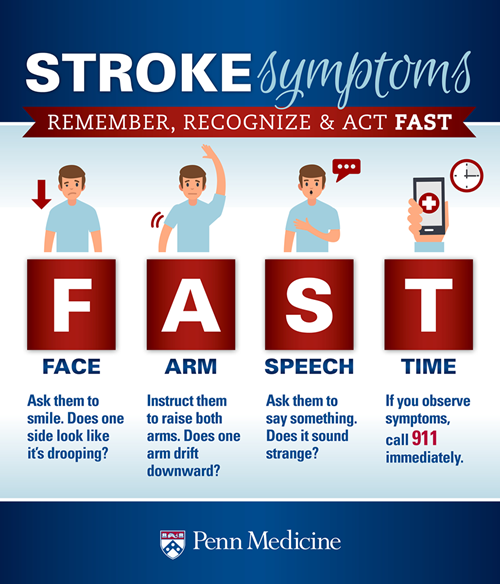
2. Note the time you first see symptoms
A clot-busting medication called tPA, or tissue plasminogen activator, tin exist given to someone if they're having a stroke, potentially reversing or stopping symptoms from developing. But information technology has to exist given inside 4.five hours of the start of symptoms, Dr. Humbert says.
Patients may also be candidates for more advanced therapies, such equally endovascular treatments, at Penn Medicine. Endovascular treatments tin involve surgically removing a clot that acquired a stroke, or fixing an aneurysm — which is a bloated blood vessel that bursts and causes haemorrhage and pressure build-up in the brain. Endovascular treatments for ischemic stroke, which are strokes related to blood clots or blockages and are the most common blazon of stroke, must be administered within 24 hours of symptom onset, and before handling improves outcomes so fourth dimension is critically important.
"If a witness sees someone develop symptoms of a stroke, the first pace is always to telephone call 911. Only closely later this, information technology would be helpful if they wait at what time the symptoms started; or if the person was constitute already with stroke symptoms, information technology is helpful to effort to effigy out the last fourth dimension y'all or someone else saw that person without any symptoms and as their normal cocky," she says. "That way, the emergency staff tin can make a more informed determination about handling options and ensure these are as safety every bit possible."
3. Perform CPR, if necessary
Most stroke patients don't crave CPR, Dr. Humbert notes. But if your friend or spouse is unconscious when yous discover them, check their pulse and animate. If you find none, call 911 and start CPR while you lot're waiting for the ambulance to get in.
You can also inquire the 911 dispatcher to walk you through how to perform CPR if you don't know or are uncertain, which consists of repeated, steady chest compressions, according to the American Center Association.
Three Things Not to Do When Someone Is Having a Stroke
1. Do not let that person get to sleep or talk y'all out of calling 911
Stroke survivors often complain of suddenly feeling very sleepy when a stroke first happens.
"A lot of patients come in and say they went to sleep for a few hours before they came to the hospital because they were tired," Dr. Humbert notes.
But time is of the essence. "The medication and any surgical treatments we tin can give a stroke survivor are incredibly time-sensitive," she adds. "They should not go to sleep, and they should non call their principal care doctor first. Instead, they should just go immediately to the emergency room."
And no matter how much someone might try to talk yous out of taking them to the infirmary, don't allow them, says Dr. Humbert.
2. Do not give them medication, nutrient, or drinks
There are two kinds of strokes:
- Hemorrhagic stroke, caused by a ruptured blood vessel leading to brain bleeds
- Ischemic stroke, acquired past a clot leading to blockage in a blood vessel
"fourscore pct of strokes are ischemic ones, but if you're in that 20 percent and your stroke was acquired by a ruptured blood vessel in the caput, you lot don't want to take aspirin," Dr. Humbert says. "And you tin't tell which i information technology is until you become to the emergency room and you go a CAT scan." Aspirin really might injure your loved 1 more than, and crusade more bleeding if in fact they are having a hemorrhagic stroke, because aspirin is a claret thinner.
To be safe, don't give someone who has stroke symptoms whatsoever medication.
You lot also shouldn't give them food or drinks earlier the ambulance comes. "Sometimes, a stroke affects their ability to swallow," Dr. Humbert says. This could ultimately cause more harm to the person if they asphyxiate and develop infections or trouble breathing.
three. Exercise not drive yourself or someone else to the emergency room
It might seem like a good idea to drive a stroke victim to the nearest emergency room. But Dr. Humbert says, "If someone is severely affected by a stroke, so you lot're improve off calling 911."
Emergency responders can starting time life-saving treatment for that person on the way to the emergency room, the Centers for Disease Control and Prevention (CDC) says. Additionally, emergency responders will ensure the person is taken to a infirmary that has the medications and treatments available to treat stroke patients immediately if that is what is going on, as non all hospitals are equipped to handle stroke patients.
You as well don't want to drive yourself to a infirmary in the event that your stroke symptoms worsen and impair your ability to drive safely.
Stay Focused and Take Action Chop-chop
Equally frightening as information technology can be to witness someone having a stroke, taking a few fundamental steps — and avoiding others — can potentially help your loved i have the best possible outcome. "Nosotros take a process in place to treat someone who is having a stroke critically in one case they go here," Dr. Humbert notes. "But they really need to get hither as rapidly as they tin."
The Symptoms That Could Hateful You're Having a Stroke
The symptoms of a stroke can vary from patient to patient. But they tend to take one thing in common: They take people by surprise, says Dr. Humbert.
"Stroke symptoms come on very suddenly," she says. "People are fine ane moment and and then all of a sudden have symptoms, such as weakness, numbness, trouble talking, or loss of vision. They might wonder where it came from."
What's happening? A stroke occurs when the blood's flow to the encephalon is dumb, either because blood flow is blocked (ischemic stroke), or a blood vessel in the encephalon ruptures leading to leakage and bleeding (hemorrhagic stroke).
Without normal claret catamenia, brain cells start to die, and the functions controlled by that expanse of the encephalon — such as speech or musculus movement or vision — are dumb or lost, the National Stroke Association says.
The effects tin crusade permanent encephalon damage and disability, depending on how severe the stroke was and how chop-chop the patient is able to become help.
What Does a Stroke Feel Like?
Strokes can conduct a number of sudden, telltale symptoms, Dr. Humbert says. These include:
- A droop on one side of the confront
- Difficulty lifting ane arm to its full tiptop or using one hand
- Difficulty moving one leg, or dragging a leg while trying to walk
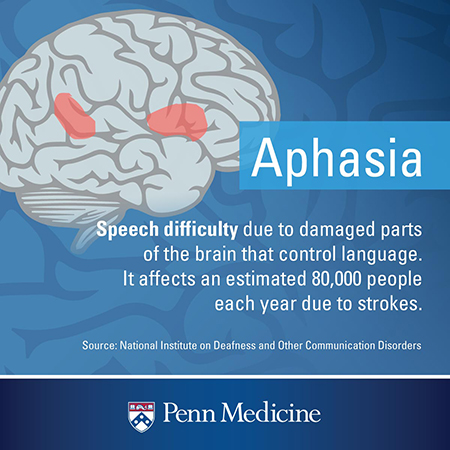
- Slurred speech or difficulty with talking
- Impaired vision in one or both optics
- Vertigo or dizziness
- Difficulty walking or sudden imbalance
The American Heart Association/American Stroke Association notes that a sudden astringent headache that does non appear to be triggered past anything is another potential sign that you might be having a stroke. Quite often, though, strokes are painless, which tin can surprise people, Dr. Humbert says.
"Although some strokes are associated with a headache, many occur without any accompanying hurting," she says. "This doesn't mean yous're not having a stroke. If you're having symptoms of a stroke, you demand to go medical intendance immediately."
Even If Symptoms Vanish Quickly, Phone call for Help
You should also exist enlightened that alert signs might concluding only for a few minutes earlier they disappear. These brief episodes are transient ischemic attacks (TIA), sometimes called "mini-strokes." They still should be taken seriously, because they tend to be signs of underlying serious conditions that tin lead to a full stroke, even possibly in the few days post-obit a TIA issue if non evaluated and treated for a TIA.
"It's not uncommon for people who accept had a TIA to ignore it because the symptoms went abroad and they don't know what it was," Dr. Humbert says. "Just people who accept TIA symptoms are definitely at higher risk of having a subsequent stroke, and they need to be evaluated urgently."
Call 911 Immediately
Once you lot recognize that you lot or someone you lot witness is having a stroke, the next step is calling 911 rapidly, Dr. Humbert stresses.
Time is critical if someone is having a stroke. The longer a stroke goes untreated, the more impairment can be done — possibly permanently — to the brain.
"If you suspect yous or someone you lot're with is having a stroke, don't hesitate to telephone call 911," Dr. Humbert says. "Information technology could save a life."
The Penn Stroke Center is a Joint Commission-certified Comprehensive Stroke Eye. Patients who have suffered a stroke take access to the most advanced resources available for the treatment of stroke 24 hours a twenty-four hour period, seven days a week, 365 days a year.
Learn More About the Penn Stroke Center
Source: https://www.pennmedicine.org/updates/blogs/neuroscience-blog/2022/march/what-to-do-if-someone-is-having-a-stroke
0 Response to "what to do if youre having a stroke"
Post a Comment